Lotter: Unearthing a Blackletter Font with Deep Historical Roots
From a 1515 Treatise to Your Modern Toolkit
Every now and then, a design asset comes along that feels less like a digital file and more like a bridge across centuries. The Lotter font family is precisely that. Its story begins not in a modern type foundry, but in Leipzig in 1515, with a book titled "A treatise by the Dominican friar-writer Marcus von Weida on the Brotherhood of the Holy Rosary," printed by the influential Melchior Lotter. The Lotter family of printers were pivotal figures, their workshop intimately connected with the burgeoning Reformation. One of their key innovations was a practical one: Melchior Lotter the elder began using Roman types for Latin texts, preserving the distinct, powerful Gothic blackletter for the German language. This typographic decision created a clear, culturally resonant hierarchy on the page.
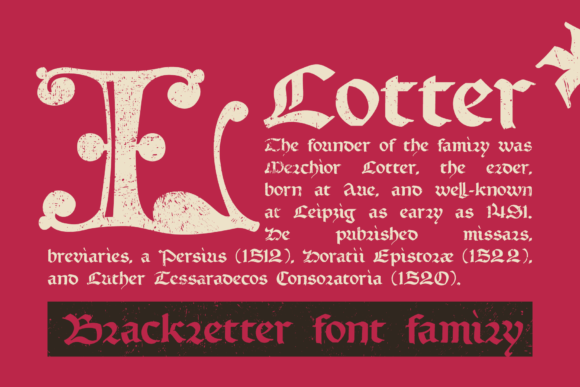
The font we have today draws its soul directly from that 1515 work. The original text was not just printed; it was elevated with hand-colored engravings of religious and liturgical themes and, most importantly, with stunning decorative initials. These initials are the direct inspiration for the Lotter typeface. It’s a premium font that captures the authentic weight, structure, and artistry of late medieval German typography. The Lotter family offers two essential styles: a bold, ornate Dropcap style for those monumental initial letters, and a Regular style for setting body text. Together, they provide everything you need to faithfully recreate the texture and feel of a Middle-Ages manuscript or early printed page.
The Visual Character: More Than Just "Old-Fashioned"
Let's be clear: Lotter is not a generic "ye olde" font. It possesses a specific personality rooted in its historical context. Visually, it’s a blackletter or Gothic script, characterized by its condensed, angular letterforms and heavy vertical strokes. This gives it a tremendous sense of solidity, seriousness, and gravitas. It feels authoritative, scholarly, and deeply traditional. The Regular style is highly legible for a blackletter font, with careful attention to spacing and form that prevents it from becoming a visual tangle. The Dropcap style, however, is where the historical artistry shines. These are not simple enlarged letters; they are intricate, decorative elements designed to command attention and signal the beginning of a new section, chapter, or idea.
As a display font, Lotter’s strength lies in its ability to make a bold, unmistakable statement. It’s a creative font that immediately sets a tone of heritage, craftsmanship, and depth. While it won’t work for a tech startup’s main website copy, it’s perfect for projects that need to convey tradition, authenticity, or a connection to history. Think of it as the typographic equivalent of hand-forged ironwork or carved wood—it speaks of time, skill, and enduring value.
Practical Applications: Where Lotter Truly Shines
Understanding where to deploy Lotter is key to leveraging its power. This is a specialist typeface, not a workhorse. Its best applications are those where its unique character becomes a core part of the message.
- Branding & Logo Design: Lotter is exceptional for brands rooted in history, craftsmanship, or tradition. Imagine it for a craft brewery, a historical preservation society, a bespoke tailor, a heritage food brand, or a university press. It instantly communicates legacy and seriousness in a logo design.
- Publishing & Editorial Design: This is a natural home for Lotter. Use it for chapter openings, title pages, or section dividers in books, especially those dealing with history, theology, or classic literature. In editorial design, the Dropcap style can transform a magazine feature or a blog header into something visually striking and memorable.
- Packaging & Print: For products that want to emphasize artisanal quality or old-world recipes, Lotter on packaging design adds an undeniable layer of authenticity. It works beautifully on labels, certificates, and high-end stationery.
- Digital & Social Media: Use it sparingly but strategically. A Lotter header on a website can set a powerful tone for the entire brand identity. For social media graphics, a single Lotter Dropcap can be the focal point of a post announcing a special event, a historical fact, or a new artisanal product launch. It stops the scroll because it’s so visually distinct from the sans serif and script fonts that dominate the feed.
Making It Work: Font Pairing and Readability
The real-world value of Lotter comes from using it wisely. Because of its intricate nature, it demands thoughtful handling, especially regarding font pairing and readability.
Font Pairing is Non-Negotiable: You would never set a full paragraph of body copy in Lotter Regular. Its dense, blackletter form is best reserved for headlines and short phrases. The key is to pair it with a highly readable, clean companion font. A classic serif font like Garamond or Caslon complements its historical feel without competing. For a more modern contrast, a clean sans serif font like Helvetica or Open Sans can create a dynamic tension between old and new. The goal is to let Lotter do the heavy lifting for impact and personality, while the paired font handles the straightforward communication of longer text.
Readability Considerations: Always prioritize your audience. Use Lotter for display purposes only. Test it at the intended size to ensure the letterforms are clear. The Dropcap initials, while decorative, should still be recognizable as letters. In digital contexts, ensure sufficient contrast and size for legibility on various screens.
Evaluate the Project Fit: Ask yourself: Does this project need to evoke tradition, history, or craftsmanship? If the answer is yes, Lotter is a strong candidate. If the project demands a sleek, futuristic, or minimalist feel, look elsewhere. Its power lies in its specific historical resonance.
Understand the Styles: The two styles—Dropcap and Regular—are designed to work in concert. Use the Dropcap to initiate a paragraph or section, then switch to the Regular style for any subsequent text that needs to feel cohesive with that initial medieval aesthetic. This combination is what creates the authentic "Middle-Ages effect."
Commercial Licensing: As with any premium font, ensure you understand the licensing terms for your intended use, whether for personal projects, client work, or commercial products. Reputable foundries provide clear licensing information.
In a digital landscape saturated with modern typography, Lotter offers a powerful way to stand out. It’s not just a design asset