Mario Wonder: A Font That Brings Playful Energy to Your Designs
Every designer, marketer, or small business owner knows the feeling: you’re staring at a blank canvas, searching for that one element that will make your project pop. Typography often holds the key, but finding a font with genuine personality—something beyond the standard workhorses—can be a challenge. Enter Mario Wonder, a display font that doesn’t just sit on the page; it performs. This isn’t just another typeface; it’s a tool for injecting immediate character and a sense of dynamic fun into your work.
More Than Just Letters: The Visual Pulse of Mario Wonder
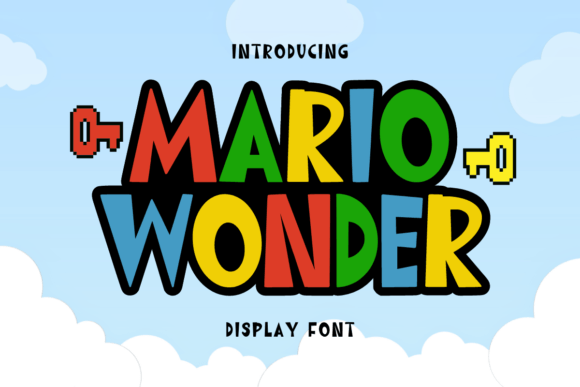
At its core, Mario Wonder is a cool, bold, and fun display font. What does that mean in practice? Its letterforms are crafted with a confident, rounded solidity that feels approachable yet assertive. There’s a subtle bounce and energy in the curves and terminals, avoiding the rigid geometry of many modern sans serif fonts. The personality is unmistakably playful and inviting, making it a fantastic creative font for projects that need to convey excitement, innovation, or a touch of whimsy. It’s the kind of typeface that can turn a simple headline into a conversation starter.
A significant practical advantage is that Mario Wonder is PUA encoded. For the uninitiated, this means every glyph, swash, and stylistic alternate is easily accessible through standard character maps in design software. You’re not limited to the basic alphabet. Want to add a decorative flourish to the tail of a ‘y’ or a unique style to a capital ‘M’? It’s all right there at your fingertips, allowing for extensive customization without technical headaches. This accessibility makes it a remarkably versatile design asset.
Where Mario Wonder Shines: Real-World Applications
The true test of any premium font is how it performs across different mediums. Mario Wonder’s bold, clear structure gives it a surprising range. It’s not a whisper; it’s a statement, making it ideal for contexts where you need to capture attention quickly and hold it.
- Brand Identity & Logo Design: For brands targeting a younger demographic, or those in tech, entertainment, food, or lifestyle sectors, Mario Wonder can form the cornerstone of a memorable logo design. Its unique character helps with brand recognition and sets a tone that’s energetic and modern.
- Marketing & Social Media: In the fast-scrolling world of social media, you have milliseconds to make an impact. Mario Wonder excels in social media graphics, ad headlines, and promotional posters. Its high legibility at larger sizes ensures your message isn’t lost.
- Packaging & Editorial Design: Imagine a fun snack brand, a children’s book cover, or the chapter titles in a lifestyle magazine. In packaging design and editorial design, this font can guide the viewer’s eye and inject personality into the layout, complementing imagery and establishing a visual hierarchy.
- Digital & Web Design: While primarily a display font, it can be used strategically in web design for hero sections, call-to-action buttons, and feature headlines. Paired with a clean, readable body font (like a neutral sans serif font or even a simple serif font), it creates a dynamic contrast that enhances the user experience.
- Personal Projects & Crafting: For hobbyists and crafters, the PUA encoding is a game-changer. Use it to create custom invitations, party decorations, t-shirt designs, or vinyl decals. The accessible swashes add a professional, handcrafted touch to personal creations.
Making It Work: Practical Guidance for Using Mario Wonder
Adopting a new display font into your toolkit requires a bit of strategy. Here’s how to integrate Mario Wonder effectively.
First, consider the project’s tone. Is your brand voice fun, innovative, and bold? If yes, Mario Wonder is likely a strong candidate. For a law firm or a luxury watch brand, it might be the wrong fit. Evaluate the font’s personality against your project’s core message. Don’t force it; let the font serve the design.
Next, master the art of font pairing. This is where Mario Wonder truly proves its worth. Its distinctive style means it pairs best with more subdued, neutral fonts. A classic combination is with a clean sans serif font for body text—think Open Sans or Lato. For a more sophisticated contrast, try a simple, readable serif font like Lora or Merriweather. The goal is balance: let Mario Wonder command the headlines while the supporting font handles the detailed reading.
Test for readability and hierarchy. Use Mario Wonder for short, impactful text: titles, headers, subheads, and callouts. Avoid setting long paragraphs in it, as its decorative nature can reduce readability in dense text blocks. Instead, use it to create a strong visual hierarchy, guiding the reader’s eye from the most important headline down to the supporting content.
Finally, review the full character set and licensing. Before you commit, explore all the glyphs and alternates available. That special swash might be perfect for your logo. And ensure you have the correct license for your use case—whether it’s for a personal blog or a commercial product line. A commercial font like Mario Wonder comes with specific terms, so understanding them is part of using it professionally.
In the end, adding a font like Mario Wonder to your library is about expanding your creative vocabulary. It’s a tool for making a bold statement, for designs that need to be remembered. Add it with confidence to your favorite creations and let the resulting designs speak with a voice that’s unmistakably vibrant and full of wonder.